
Maybe one reason people think that it is impossible
to determine what is absolutely true
is that no one has told them about
congruence.
Part 1. The Term Itself
I love this word. Even more, I love the concept it embodies. I love its usefulness in identifying unchanging truth. Congruence is a pair of clip-on lenses that increases your intellectual depth perception. Tether congruence around your neck and you’ll be ready to peer behind the façades of pithy pronouncements by popular, public figures. More on this accessory in Part 2.
Right now, it’s etymology time! Like, where did this word come from, and why do I need it? Good questions. Let’s take your first one.
Using my sharpened hyphen, I’m going to slice this word congruence into two pieces. There! Now, the piece on the left is “con”. The word con comes from–uh, let’s use examples instead.
Have you ever ordered “agua con gas” in Ensenada or Escondido? Then you know that “con” means “with”. You ordered water with gas. In other words, fizzy water. Are you with me? So, the piece on the left means “with”, at least in this word.
Shifting your gaze to the right and you see “-gruence”. Not what they feed you in prison. That would be gruel, rhymes with cruel. This “-gruence piece means “-greement”, or agreement. Congruent (with the t) means “in agreement”.
Now, carefully switch the pieces around, ditch the hyphen, and you get “agreement with”. We’re talking about things that fit together exactly. We’re talking lots of things that all fit together exactly. You, the geometry people, the triangle people, you discuss congruence while cutting sandwiches diagonally into two equal halves. Flip one over, stack ‘em, and if you’ve cut them carefully, they are congruent, even if a pickle falls out.
Why do you need this word? Check this out.
The opposite of congruent is incongruent. Sample sentence:
“A lot of popular philosophy that is being lapped up by folks today is incongruent with everyday facts and realities of life.”
Not such a bad sentence, really.
Part 2. Sorting Through Truth Claims
Truth claims holding a bullhorn to our ears are not few. A quick look at the content of each and it quickly becomes plain to the logical thinker that they all cannot be completely true. A longer look at their innards and we find most systems claiming to be truth cannot completely account for all the realities of our gut experience.
In Part 1, we dusted off an old tool for sifting through claims of truth supposedly dropped upon mankind from outside Planet Ghetto. Let’s pick up that tool and get to work.
Let’s make one thing clear right now. Our search is not to find TFY/TFM, truth for you/truth for me. There is a place for such relative truths. Do you like unsweetened Bulgarian yogurt on your fruit, or must you add sugar?
Our search is for truth that applies to all of us, all of us earthlings. Truth with a capital T. If, after carefully checking out the most reasonable candidates for Truth, they all flunk out, we would then be free to flounder in chaos. In fact, we’ll make a lot of our own chaos, thank you.
The easy way out of this challenge is to simply opt for chaos and make the best of it. “If I waste my life, I waste my life…okay?” Okay. You don’t really need my permission.
I do offer a shortcut. Two of the greatest intellects and writers proudly claimed by the Brits took the long route. If they were scouts in an uncharted land, we’ll be the surveyors who design the freeway.
Consider G.K. Chesterton, author of over 5,000 pieces, journalist, editor, and debater supreme. His intellectual enemies would line up for a chance to debate him just because he displayed such keen wit in defeating them. As to his early beliefs, Chesterton puts it this way; he was just putting the finishing touches on the perfect religion that he was designing when he discovered that it already existed. It is orthodox Christianity.
C.S. Lewis, an Irish atheist and professor of literature at Cambridge and Oxford, also took the long route. First, he took the time for honest thought, something rare among atheists. When atheism inevitably failed him, he went on to explore many philosophies. It was through this journey that he finally “regressed”, as he put it, into the Christianity that was at his elbow.
For this moment, I am at your elbow. Maybe you imagine yourself to be more brilliant than these two timeless intellects. If not, I suggest that you start with the Christianity that proved congruent with all of reality for these two fog dispelling authors.
Part 3. The Congruent Shortcut
In Part 2, I identified a long road, and a shortcut to unchangeable Truth, Truth for all. I will not dissuade you if the long route is what you choose. The shortcut I will next propose, is not so much a shortcut as an avoidance of unnecessary detours. Let’s get started.
Wandering can be interesting. Many who wander are truly lost!
Years ago, up in the High Sierras, I slipped out of a campground for an early morning walk. I took off through the trees. In short order, I was completely lost.
After considerable wandering I came across wheel tracks. Relieved, I followed them. They ended in the trees. I brilliantly concluded that following the tracks in the opposite direction would get me back to mankind.
There is no shortage of alluring forests and paths for the truth trekker. Many promising tire tracks have led to dead ends. Better, I think, to take the more established route to a destination, get there and get set up to live. Then go back and see what was so distracting to the others who have yet to arrive.
Take a look at the chart below. It shows many of the life experiences that almost everyone would like explained.
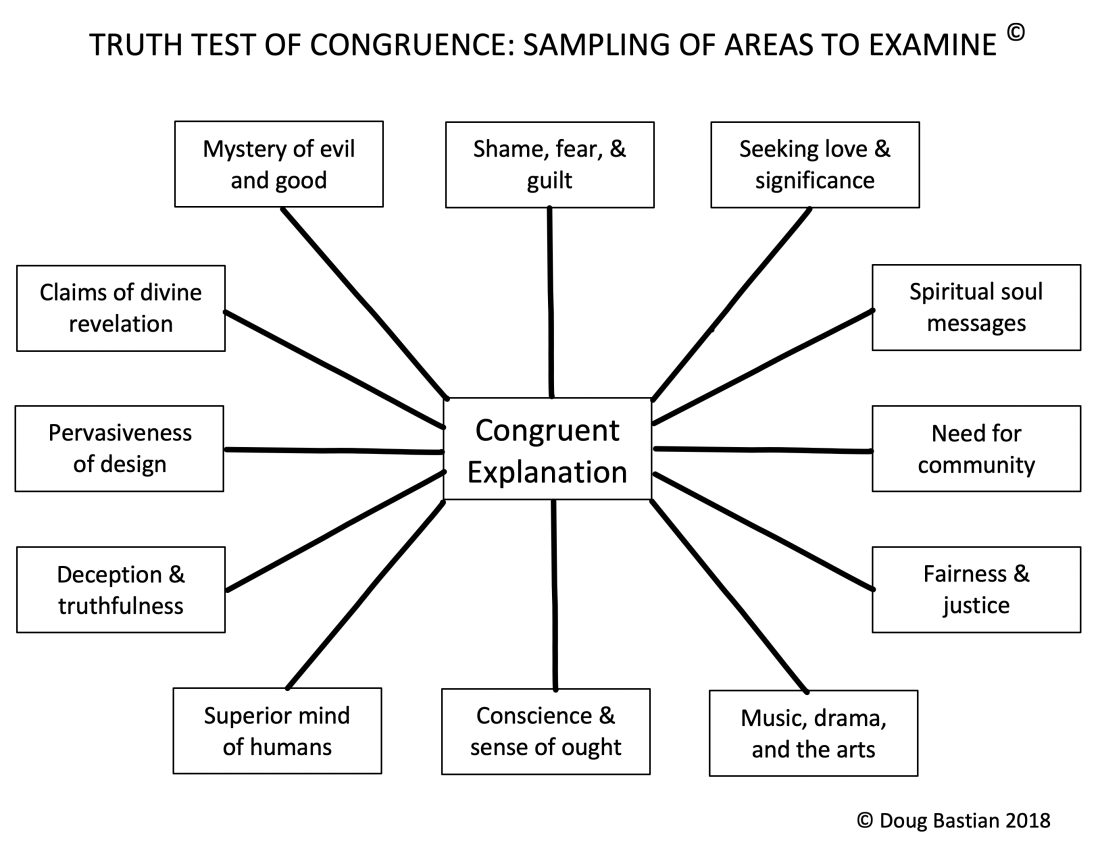
I have been a student of history and of philosophy and of logic. I have spent nearly a lifetime studying and applying the Bible to life. So, when I suggest you start using your new congruence tool on the Bible, I’m not just parroting something I picked up on the street.
What kind of answers will you find? You will find answers that are entirely congruent with all human experience. The breadth of human concerns that are addressed boldly and frankly in these Scriptures will amaze you over time. And, along the way, you learn what to do about what you find.
Really, my shortcut is not so much a shortcut as it is an avoidance of unnecessary detours. The Bible is inexhaustible, but it is also plainly understandable. It is story, and its stories will connect with your story.
Here is what I have seen happen many times. Start your journey to Truth by reading and re-reading the Bible. Before long you will likely find yourself gripped by its harmonious message.
As one person put it, whose identity has been lost to me, “I have read many books, most of which I easily understood. When I read the Bible, I found the book that understood me.”
As the author of the Bible Book of Hebrews put it,
“For the word of God is living and powerful and sharper than any two-edged sword, piercing even to the division of soul and spirit, and of joints and marrow, and is a discerner of the thoughts and intents of the heart. And there is no creature hidden from His sight, but all things are naked and open to the eyes of Him to whom we must give account.” Hebrews 4:12-13.
You’ll wonder why you didn’t take this road sooner. ~dkb~

 'ink Again
You must be logged in to post a comment.